Bowellism (High-Tech)

Rogers and Piano's Centre Pompidou turned the building inside out — color-coded ducts on the facade, escalators in transparent tubes, structure expressed as spectacle — and created the most photographed cultural building in the world.

Compare Bowellism (High-Tech) with another style →
Record020-AB
AestheticBowellism (High-Tech)
ClassExpressive / Maximal
StatusINGESTING
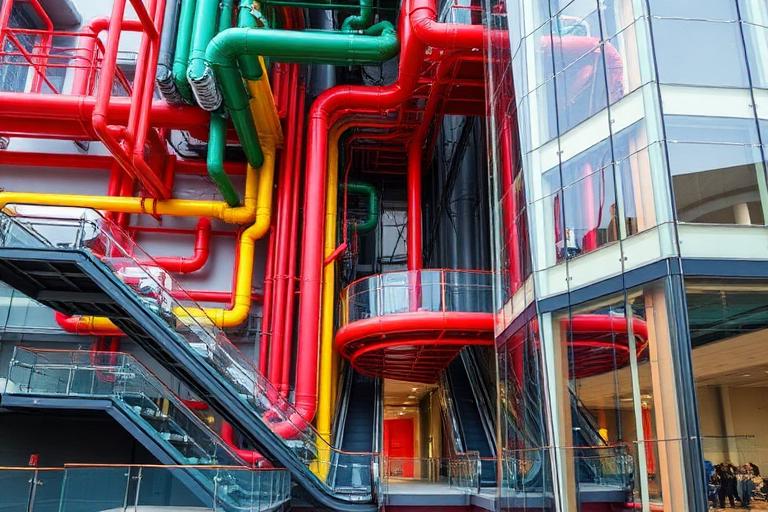
Example of the Bowellism (High-Tech) aesthetic
Archive platearch bowellism

Source document

Registrar's index cards on the platen glass — captured by the scanner

Elio Archive — Registrar's OfficeBowellism (High-Tech)FILE 020-AB
When to use it
  • Brand identity celebrating transparency of process, structure, and systems
  • Technology and engineering brand that wants to make complexity legible and beautiful
  • Architecture firm identity built around expressive structure and mechanical systems
  • Cultural institution brand positioning its inner workings as the public attraction
Perfect for
  • Engineering, infrastructure, and technology companies making systems visible
  • Architecture firms with an expressive structural and mechanical approach
  • Science museums and technology centers communicating how things work
  • Manufacturing and industrial brands where process is the brand story
What it looks like
  • Renzo Piano + Richard Rogers — Centre Pompidou, Paris (1977)
  • Richard Rogers Partnership — Lloyd's of London (1986)
  • Norman Foster — HSBC Main Building, Hong Kong (1985)
  • Nicholas Grimshaw — International Terminal, Waterloo Station, London (1993)

Aesthetic profile

8-channel console — dominant channels taped & circled by the registrar

Attribute Console — 020-AB 8 CH ACTIVEFIG. 1
CH01Minimal
MaximalR·50
CH02Analog
DigitalR·40
CH03Restrained
ExpressiveR·60
CH04Cool
WarmL·20
CH05Futuristic
NostalgicL·40
CH06Structured
ChaoticR·50
CH07Dark
LightR·10
CH08Organic
GeometricL·40

strongest channels circled — leans expressive, maximal, chaotic ✦

Profile card

Your aesthetic passport — share the fingerprint

Aesthetic Profile
Bowellism (High-Tech)
Postmodern
1970–1990
MaximalDigitalExpressiveCoolFuturisticChaoticLightOrganic
ExpressiveMaximalChaotic4 materials
eliosignal.com/styles/arch-bowellism

Material assembly

The style's primary materials, assembled bottom-up

Tap a stratum for material detail · Full catalog

Place in history

Postmodern · 1970–1990 — tap any style to travel

Mood Board

Sign in to generate

Sign in to generate a mood board

Sign in

Editorial Depth

Sign in to unlock

Historical Context
Key Practitioners
What to Avoid

Sign in for editorial depth

Sign in

Cross-references

Industrial ArchitectureNeo-FuturismArchitectural ModernismConstructivism

About this aesthetic

What is the Bowellism (High-Tech) aesthetic?
Rogers and Piano's Centre Pompidou turned the building inside out — color-coded ducts on the facade, escalators in transparent tubes, structure expressed as spectacle — and created the most photographed cultural building in the world.
When should I use the Bowellism (High-Tech) aesthetic?
Use it for: Brand identity celebrating transparency of process, structure, and systems; Technology and engineering brand that wants to make complexity legible and beautiful; Architecture firm identity built around expressive structure and mechanical systems; Cultural institution brand positioning its inner workings as the public attraction.
What is the Bowellism (High-Tech) style perfect for?
Perfect for Engineering, infrastructure, and technology companies making systems visible, Architecture firms with an expressive structural and mechanical approach, Science museums and technology centers communicating how things work, Manufacturing and industrial brands where process is the brand story.
What does the Bowellism (High-Tech) aesthetic look like?
Visuals typically feature: Renzo Piano + Richard Rogers — Centre Pompidou, Paris (1977); Richard Rogers Partnership — Lloyd's of London (1986); Norman Foster — HSBC Main Building, Hong Kong (1985); Nicholas Grimshaw — International Terminal, Waterloo Station, London (1993).

Build with the bowellism (high-tech) aesthetic

Elio turns aesthetic references into on-brand visuals. Generate, compose and publish from one studio.

Join the waitlist