Metabolism

Buildings imagined as living organisms — Japan's Metabolists designed megastructures that could grow, adapt, and shed parts, with plug-in capsule units clipped onto service cores, a radical post-war vision of the city as biology.

Compare Metabolism with another style →
Record020-AM
AestheticMetabolism
ClassExpressive / Maximal
StatusINGESTING
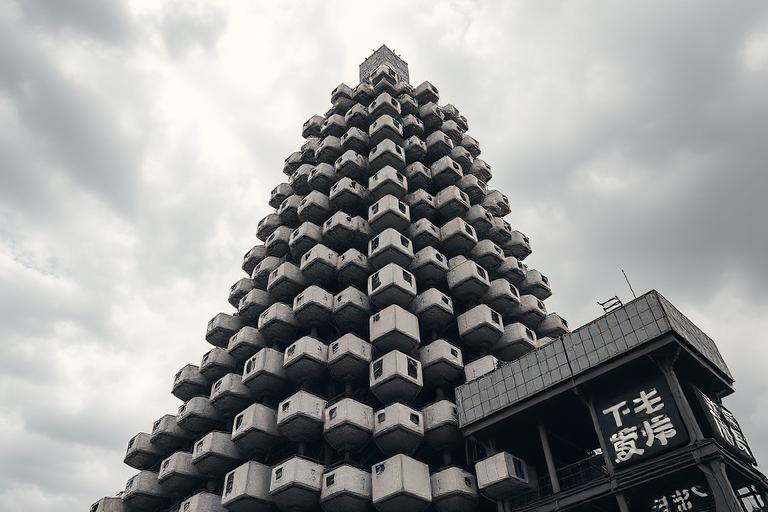
Example of the Metabolism aesthetic
Archive platearch metabolism

Source document

Registrar's index cards on the platen glass — captured by the scanner

Elio Archive — Registrar's OfficeMetabolismFILE 020-AM
When to use it
  • Brand identity around modularity, growth, and systems thinking
  • Tech and infrastructure brands expressing adaptive architecture
  • Editorial on urbanism, futurism, and Japanese design history
  • Campaigns built on repeatable, clip-on modular units
Perfect for
  • Modular construction, prefab, and infrastructure companies
  • Tech platforms framing themselves as living, growing systems
  • Cultural institutions covering Japanese post-war design
  • Futurist and speculative-design practices
What it looks like
  • Kisho Kurokawa — Nakagin Capsule Tower, Tokyo (1972)
  • Kenzo Tange — Yamanashi Press and Broadcasting Center (1966)
  • Kiyonori Kikutake — Marine City proposals (1958)
  • Expo '70 — Metabolist master plan, Osaka (1970)

Aesthetic profile

8-channel console — dominant channels taped & circled by the registrar

Attribute Console — 020-AM 8 CH ACTIVEFIG. 1
CH01Minimal
MaximalR·40
CH02Analog
DigitalR·20
CH03Restrained
ExpressiveR·50
CH04Cool
WarmL·30
CH05Futuristic
NostalgicR·30
CH06Structured
ChaoticR·30
CH07Dark
LightCTR·0
CH08Organic
GeometricL·20

strongest channels circled — leans expressive, maximal, cool ✦

Profile card

Your aesthetic passport — share the fingerprint

Aesthetic Profile
Metabolism
Postwar
1959–1975
MaximalDigitalExpressiveCoolNostalgicChaoticLightOrganic
ExpressiveMaximalCool4 materials
eliosignal.com/styles/arch-metabolism

Material assembly

The style's primary materials, assembled bottom-up

Tap a stratum for material detail · Full catalog

Place in history

Postwar · 1959–1975 — tap any style to travel

Mood Board

Sign in to generate

Sign in to generate a mood board

Sign in

Editorial Depth

Sign in to unlock

Historical Context
Key Practitioners
What to Avoid

Sign in for editorial depth

Sign in

Cross-references

BrutalismStructuralismMonolithic ArchitectureArchitectural Futurism

About this aesthetic

What is the Metabolism aesthetic?
Buildings imagined as living organisms — Japan's Metabolists designed megastructures that could grow, adapt, and shed parts, with plug-in capsule units clipped onto service cores, a radical post-war vision of the city as biology.
When should I use the Metabolism aesthetic?
Use it for: Brand identity around modularity, growth, and systems thinking; Tech and infrastructure brands expressing adaptive architecture; Editorial on urbanism, futurism, and Japanese design history; Campaigns built on repeatable, clip-on modular units.
What is the Metabolism style perfect for?
Perfect for Modular construction, prefab, and infrastructure companies, Tech platforms framing themselves as living, growing systems, Cultural institutions covering Japanese post-war design, Futurist and speculative-design practices.
What does the Metabolism aesthetic look like?
Visuals typically feature: Kisho Kurokawa — Nakagin Capsule Tower, Tokyo (1972); Kenzo Tange — Yamanashi Press and Broadcasting Center (1966); Kiyonori Kikutake — Marine City proposals (1958); Expo '70 — Metabolist master plan, Osaka (1970).

Build with the metabolism aesthetic

Elio turns aesthetic references into on-brand visuals. Generate, compose and publish from one studio.

Join the waitlist