Googie

Space Age optimism in roadside form — Googie threw boomerang roofs, atomic starbursts, cantilevered canopies, and neon into the American car landscape, selling the future one coffee shop and gas station at a time.

Compare Googie with another style →
Record020-AG
AestheticGoogie
ClassExpressive / Maximal
StatusINGESTING
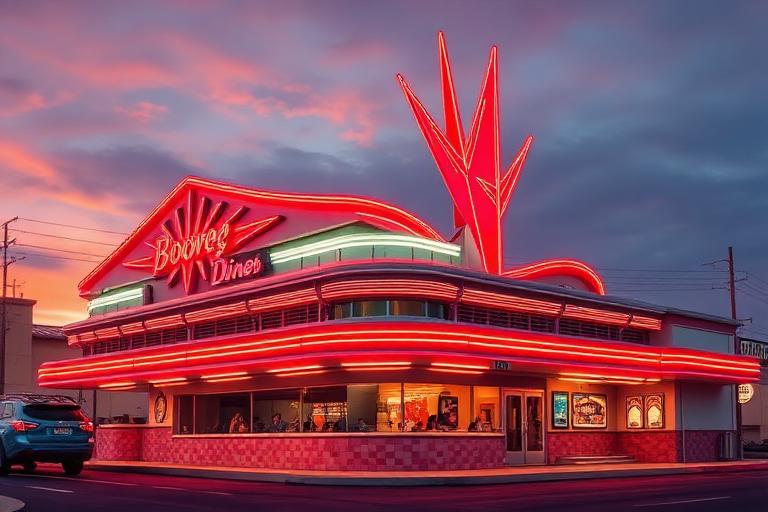
Example of the Googie aesthetic
Archive platearch googie

Source document

Registrar's index cards on the platen glass — captured by the scanner

Elio Archive — Registrar's OfficeGoogieFILE 020-AG
When to use it
  • Brand identity channeling retro-futurist, atomic-age optimism
  • Signage and campaigns with bold neon, starbursts, and motion
  • Entertainment, food, and roadside hospitality with playful pop
  • Nostalgic mid-century Americana with a forward-looking twist
Perfect for
  • Diners, drive-ins, bowling alleys, and roadside attractions
  • Entertainment and theme brands selling fun and spectacle
  • Retro product and toy brands with Space Age flair
  • Hospitality referencing 1950s–60s Southern California
What it looks like
  • Armét & Davis — Norms Restaurant, Los Angeles (1957)
  • Pereira & Luckman — LAX Theme Building (1961)
  • Welton Becket — Capitol Records Building, Hollywood (1956)
  • The Googie coffee shops of Route 66 (1950s)

Aesthetic profile

8-channel console — dominant channels taped & circled by the registrar

Attribute Console — 020-AG 8 CH ACTIVEFIG. 1
CH01Minimal
MaximalR·60
CH02Analog
DigitalL·30
CH03Restrained
ExpressiveR·70
CH04Cool
WarmR·40
CH05Futuristic
NostalgicR·50
CH06Structured
ChaoticR·30
CH07Dark
LightR·40
CH08Organic
GeometricR·20

strongest channels circled — leans expressive, maximal, nostalgic ✦

Profile card

Your aesthetic passport — share the fingerprint

Aesthetic Profile
Googie
Postwar
1945–1969
MaximalAnalogExpressiveWarmNostalgicChaoticLightGeometric
ExpressiveMaximalNostalgic4 materials
eliosignal.com/styles/arch-googie

Material assembly

The style's primary materials, assembled bottom-up

Tap a stratum for material detail · Full catalog

Place in history

Postwar · 1945–1969 — tap any style to travel

Mood Board

Sign in to generate

Sign in to generate a mood board

Sign in

Editorial Depth

Sign in to unlock

Historical Context
Key Practitioners
What to Avoid

Sign in for editorial depth

Sign in

Cross-references

Streamline ModerneArchitectural FuturismMid-Century ModernNeo-Futurism

About this aesthetic

What is the Googie aesthetic?
Space Age optimism in roadside form — Googie threw boomerang roofs, atomic starbursts, cantilevered canopies, and neon into the American car landscape, selling the future one coffee shop and gas station at a time.
When should I use the Googie aesthetic?
Use it for: Brand identity channeling retro-futurist, atomic-age optimism; Signage and campaigns with bold neon, starbursts, and motion; Entertainment, food, and roadside hospitality with playful pop; Nostalgic mid-century Americana with a forward-looking twist.
What is the Googie style perfect for?
Perfect for Diners, drive-ins, bowling alleys, and roadside attractions, Entertainment and theme brands selling fun and spectacle, Retro product and toy brands with Space Age flair, Hospitality referencing 1950s–60s Southern California.
What does the Googie aesthetic look like?
Visuals typically feature: Armét & Davis — Norms Restaurant, Los Angeles (1957); Pereira & Luckman — LAX Theme Building (1961); Welton Becket — Capitol Records Building, Hollywood (1956); The Googie coffee shops of Route 66 (1950s).

Build with the googie aesthetic

Elio turns aesthetic references into on-brand visuals. Generate, compose and publish from one studio.

Join the waitlist