Deconstructivism

Fragmentation as architecture — Deconstructivism shattered the box into colliding planes, skewed angles, and controlled chaos, rejecting the right angle, from Gehry's titanium folds to Zaha Hadid's flying geometries and Libeskind's fractured voids.

Compare Deconstructivism with another style →
Record020-AD
AestheticDeconstructivism
ClassExpressive / Chaotic
StatusINGESTING
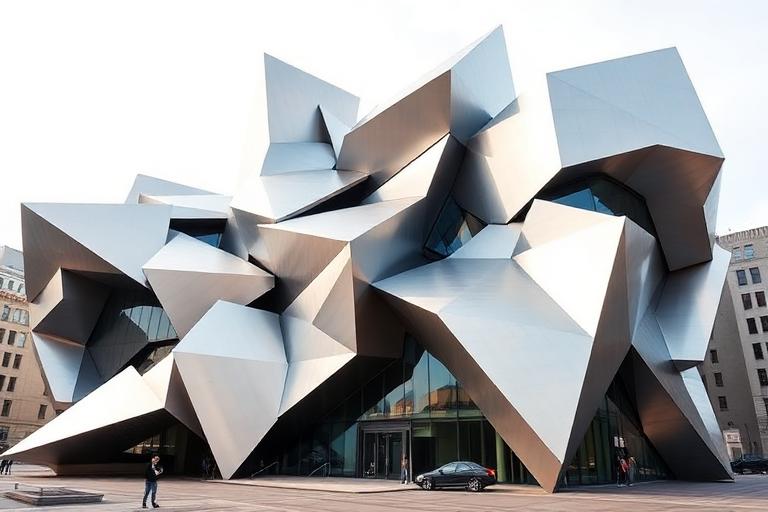
Example of the Deconstructivism aesthetic
Archive platearch deconstructivism

Source document

Registrar's index cards on the platen glass — captured by the scanner

Elio Archive — Registrar's OfficeDeconstructivismFILE 020-AD
When to use it
  • Brand identity demanding boldness, disruption, and dynamism
  • Campaigns for culture, fashion, or tech that reject convention
  • Editorial and motion design with fragmented, angular energy
  • Spatial and exhibition design built on instability and tension
Perfect for
  • Cultural institutions — museums, concert halls — with civic ambition
  • Fashion and luxury brands trading on the avant-garde
  • Tech and innovation brands signalling radical disruption
  • Architecture firms with an expressive, sculptural practice
What it looks like
  • Frank Gehry — Guggenheim Museum Bilbao (1997)
  • Zaha Hadid — Vitra Fire Station, Weil am Rhein (1993)
  • Daniel Libeskind — Jewish Museum, Berlin (2001)
  • Coop Himmelb(l)au — Rooftop Remodelling, Vienna (1988)

Aesthetic profile

8-channel console — dominant channels taped & circled by the registrar

Attribute Console — 020-AD 8 CH ACTIVEFIG. 1
CH01Minimal
MaximalR·50
CH02Analog
DigitalR·30
CH03Restrained
ExpressiveR·70
CH04Cool
WarmL·30
CH05Futuristic
NostalgicL·30
CH06Structured
ChaoticR·70
CH07Dark
LightL·10
CH08Organic
GeometricR·30

strongest channels circled — leans expressive, chaotic, maximal ✦

Profile card

Your aesthetic passport — share the fingerprint

Aesthetic Profile
Deconstructivism
Postmodern
1982–2000
MaximalDigitalExpressiveCoolFuturisticChaoticDarkGeometric
ExpressiveChaoticMaximal1 materials
eliosignal.com/styles/arch-deconstructivism

Material assembly

The style's primary materials, assembled bottom-up

Tap a stratum for material detail · Full catalog

Place in history

Postmodern · 1982–2000 — tap any style to travel

Mood Board

Sign in to generate

Sign in to generate a mood board

Sign in

Editorial Depth

Sign in to unlock

Historical Context
Key Practitioners
What to Avoid

Sign in for editorial depth

Sign in

Cross-references

Parametric ArchitectureNeo-FuturismBlobitectureArchitectural Postmodernism

About this aesthetic

What is the Deconstructivism aesthetic?
Fragmentation as architecture — Deconstructivism shattered the box into colliding planes, skewed angles, and controlled chaos, rejecting the right angle, from Gehry's titanium folds to Zaha Hadid's flying geometries and Libeskind's fractured voids.
When should I use the Deconstructivism aesthetic?
Use it for: Brand identity demanding boldness, disruption, and dynamism; Campaigns for culture, fashion, or tech that reject convention; Editorial and motion design with fragmented, angular energy; Spatial and exhibition design built on instability and tension.
What is the Deconstructivism style perfect for?
Perfect for Cultural institutions — museums, concert halls — with civic ambition, Fashion and luxury brands trading on the avant-garde, Tech and innovation brands signalling radical disruption, Architecture firms with an expressive, sculptural practice.
What does the Deconstructivism aesthetic look like?
Visuals typically feature: Frank Gehry — Guggenheim Museum Bilbao (1997); Zaha Hadid — Vitra Fire Station, Weil am Rhein (1993); Daniel Libeskind — Jewish Museum, Berlin (2001); Coop Himmelb(l)au — Rooftop Remodelling, Vienna (1988).

Build with the deconstructivism aesthetic

Elio turns aesthetic references into on-brand visuals. Generate, compose and publish from one studio.

Join the waitlist